Garden design in a changing climate

How Small Steps Can Make a Big Impact
As climate change accelerates, our planet is nearing a critical threshold. Global temperatures are on track to hit 1.5°C of warming imminently with projections suggesting we could face 2°C to 2.7°C by the end of the century. This marks a departure from the stable climate of the Holocene when climate conditions have been ideal for human societies to thrive. While decisive action is needed from governments and corporations, landowners and designers have a unique opportunity to make meaningful contributions. Every step we take, no matter how small, can add up to a significant difference.

Here are some practical ways to adapt gardens and landscape designs to combat and mitigate the effects of climate change.

1. Create Habitats Based on Light and Water

Understanding a garden’s microclimates is a vital first step. Observe how sunlight falls in the space. Where is the garden bathed in full sun? Which areas are shaded and which shift between sun and shade? How does water flow or pool in the landscape?

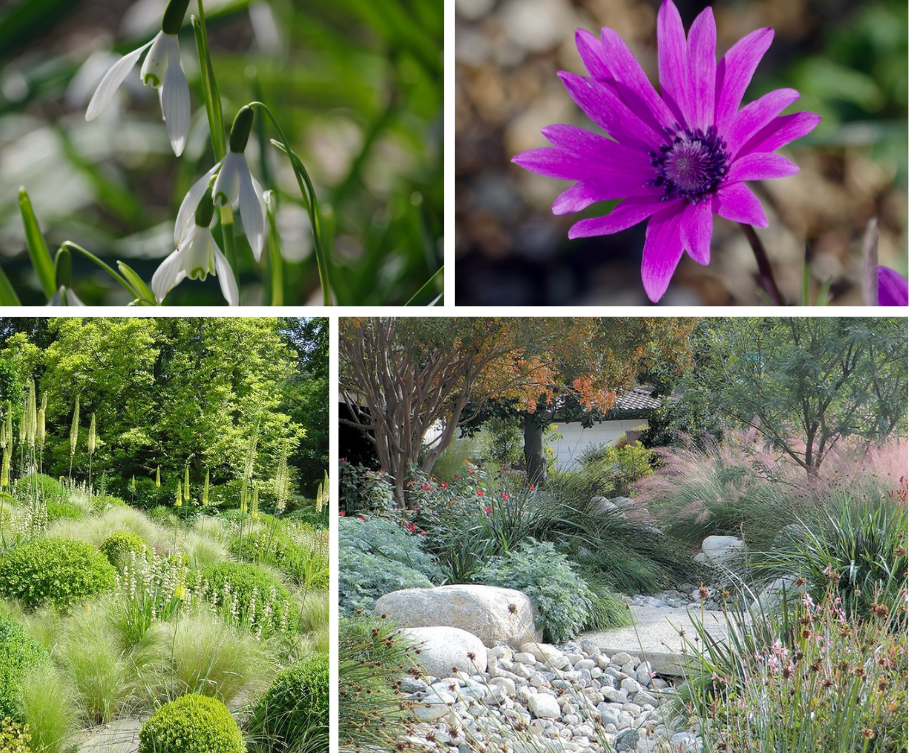
Designing habitats suited to these conditions fosters biodiversity. Sunny dry spots, for example, are ideal for drought-resistant plants like lavender or grasses. Shady, damp area support ferns, mosses and shade-loving perennials.

Thoughtful planting creates thriving ecosystems that support insects, birds, and other wildlife.

2. Reduce Hard Landscaping

While patios and terraces are often practical, overusing hard landscaping can harm the environment. Large paved areas prevent water from soaking into the soil increasing the risk of flooding. They reflect heat, exacerbating the urban heat island effect. And they reduce available green space for wildlife.

Consider what’s truly necessary and scale back where possible. Minimising hardscaping creates more opportunities to plant greenery, enhancing biodiversity and improving soil health.

3. Plant Trees Wherever Possible

Trees are the unsung heroes of climate adaptation. They absorb carbon dioxide and air pollution. They provide shade and keep temperatures cooler whilst creating critical habitats for birds, insects and other species.

In a warming world, increased canopy cover will be essential for maintaining livable environments. Think of trees as the backbone of the design. Build paths, seating areas, and other elements around them to preserve and highlight their beauty and benefits.

4. Think Big, Act Locally

The global climate crisis demands systemic change but grassroots efforts are just as crucial. Gardens, no matter their size, have the potential to support larger ecosystems. By making intentional, sustainable design choices, we all contribute to a collective effort to safeguard our future.

Together we can create greener, cooler and more resilient spaces that not only combat climate change but also restore a connection to the natural world. Let’s make every garden count!
Ecological Garden Design: Connecting with Nature

While I was a student at the London College of Garden Design, I started to explore what it means to create gardens in an ecological way. Before starting my diploma, I spent several years researching how we can restore balance to planetary ecosystems. I was fascinated by the ways that indigenous peoples speak about nature and their relationships with the living world around them. I immersed myself in understanding how twenty-first century lifestyles often leave us feeling disconnected from nature even though we are interdependent with all of nature’s processes. Ecological design tries to reconnect us with the natural world at the same time as creating biodiverse and biocomplex landscapes that help nature to thrive.

Embracing our interconnectedness with nature creates a different kind of relationship, one in which we think beyond a purely social, scientific or aesthetic appreciation. I loved reading Robin Wall Kimmerer’s descriptions of working in her garden in Braiding Sweetgrass. She spent years restoring her pond and describes how her life became materially and spiritually intertwined with it. She writes ‘I worked on the pond and the pond worked on me. Together we made a good home’. This feeling of connection to our piece of land increases our wellbeing – it boosts our mood, helps us to think better and can give us a greater sense of meaning and satisfaction with life. Ecological gardens connect you while nature flourishes too.

As I worked through my diploma, my own design principles started to emerge: work with what’s already there; understand how light and shade affect the garden; explore the soil; reuse materials if possible by crushing old stone or concrete; use a mix of native and introduced species to create complexity; create vertical layers of with trees, shrubs, grasses, perennials and ground cover.  For sure, my principles will grow and change as I grow my business and I will write more about this. If you’d like to chat, please get in touch at gill@gillhallgardens.co.uk

https://www.gillhallgardens.co.uk/

Robin Wall Kimmerer Braiding Sweetgrass: Indigenous Wisdom, Scientific Knowledge and the Teachings of Plants Minneapolis, Minnesota: Milkweed Editions 2013

Wildflowers in the desert

Cali wildflowers 3

Photographs of the California super blooms caught my eye this week. The colour and movement in these images feels like an invitation into life – past, present and future all contained in a single moment. Each stem, each petal, each leaf sings hurrah for life, yes to be here, yes to be alive, yes to be seeing, touching, feeling, tasting, smelling, thinking, hearing. I wanted to feast my eyes on the colours, to drink them in and then roll down the hillsides. I imagined those flowers swaying in the gentle wind and their fragrance exploded in my senses. Who knew the shot of wild joy to be experienced at the simple thought of nature’s remote exuberance?

These small moments have the potential to invite us into the sacred. Mary Oliver’s words for a summer’s day came to mind ..

I don’t know exactly what a prayer is.
I do know how to pay attention, how to fall down
into the grass, how to kneel down in the grass,
how to be idle and blessed, how to stroll through the fields,
which is what I have been doing all day.

Then my attention came to the world as it is today, at capacity with senseless violence, habitat destruction, deepening inequality and the prospect of ever more climate events devastating homes and livelihoods across continents. Is it reckless to think and write about yellow and purple flowers when we live surrounded by so much that needs to change? What is our response to beauty and the sensory encounter it brings when we are simultaneously horrified and full of grief at world events?  Perhaps these exquisite, fleeting glimpses of carefreeness are the very things that enable us to carry on, to believe in a better future and to work towards it. Perhaps this sense of aliveness is itself what’s needed … I wonder what is incumbent on those who see and feel this? What does the world ask of each of us right now?


If we want to change the world

lenses

‘The world we have created is a product of our thinking; it cannot be changed without changing our thinking. If we want to change the world we have to change our thinking…no problem can be solved from the same consciousness that created it. We must learn to see the world anew’.

Albert Einstein

We start to create our own world from the moment we are born. We build our identity and sense of self , first in relation to the caregivers around us and then in relationship to the wider world we encounter. We develop our own sense of direction and moral compass. We learn quickly what behaviour receives approval from our family members, social groups, institutions and communities. Sometimes our world undergoes a radical rethink as we navigate our adult lives.

Our complete life experience contributes to the shape and colour of the lenses through which we see the world. These lenses determine how connected we feel, how much we care and how much we want to change things. This is our consciousness, our subjective experience of being ‘me’. And each lens is different, giving each of us a unique perspective on how the world looks and feels and what it is to be human.

There can be no doubt that our human activity is damaging the beautiful, abundant and medicinal environment that planet Earth provides us. Yet how can we mobilise each and every human on the planet into having an awareness of equitable and sustainable living? What will it take for that level of change to take place?

We need to change the lenses we wear to see the world differently. Instead of those trendy tortoiseshell frames, why not try a pair that are recycled or sustainably-sourced? How does the world appear when you see it from a different viewpoint?

This shift in consciousness is how we start to perceive the world anew. And if enough people commit to changing the way they see the world, if Einstein got it right, we can shift the consciousness of the entire Earth community.

For everyone – from politicians and corporate leaders to individuals in towns, cities and villages – the journey of conscious transformation begins with a change in understanding at the most personal level. Only then is wider transformation possible.

Learning to see the world anew takes courage, commitment and community. Yet if we can shift our thinking – or alter the lens through which we observe life – if only by a tiny degree, we can reap unimaginable benefits.

The miracle of the humble bee

Bee

‘There is one masterpiece, the hexagonal cell, that touches perfection – a perfection that all the geniuses in the world, were they to meet in conclave, could in no way enhance. No living creature .. has achieved, in the centre of her sphere, what the bee has achieved in her own: and were someone from another world to descend and ask of the earth the most perfect creation of the logic of life, we should needs have to offer the humble comb of honey’.

Maurice Maeterlinck, The Life Of The Bee

The brain of a bee is the size of a sesame seed and yet these tiny creatures are capable of incredible things. For over 100 million years, they have been working together in community, tirelessly pollinating the earth and producing that great elixir of life – honey. Faster than any human-built technology, these miniature minds navigate the most efficient routes for their nectar-gathering as they travel from flower to flower.

Whilst most of their compatriots are solitary, the honey bee lives harmoniously in hives of up to 80,000. Existing in such densely populated conditions could prove problematic to many species, but honey bees work together as a team. Their lives, set out before they are even born, are of work and dedication to the cause of the collective. They are agile – willing and able to swap roles within the hive, according to its needs.

When threatened, bees act selflessly, coming together as a swarm to give their own lives to protect the hive and save the queen. If a wasp gets into the hive, for example, the bees surround it to suffocate or ‘thermoball’ it. By vibrating their muscles, a group of bees raise the temperature so dramatically around the intruder that it can no longer survive the heat and becomes asphyxiated.

Honey itself is something of a miracle product – the only substance produced by insects that human beings can eat. Containing , vitamins, minerals and enzymes, it’s a complete food and yet is also known for its healing properties. Its use as a dressing on the wounds of soldiers in the First World War is just one example

Plus, it’s resilient – archaeologists excavating the ancient Egyptian pyramids found honey in sealed jars which, apparently, still tasted great. And it was 3,000 years old. No other food product is able to remain in this perfectly edible form for so long. This tiny,  ingenious and generous creature reminds us of the miracle of nature every time she flies by.


What nature can teach us about renewal

DSCF2222 (4)

“I should not count on outside help. Survival had to start with me.”

Yann Martel, Life of Pi

Waking up to sunshine, as most of Britain has done since May, is a beautiful way to start the day. Yet having had no rain for almost two months, our green and pleasant lands have become scorched and without colour. London’s Royal Parks look like African plains, as resident herds of deer wander slowly through acres of parched, yellow grasses.

Now that water is scarce, plants and grasses dry out if not watered by human hands. Shrinking in size and putting on hold their usual exuberant mid-summer growth,  flowers and shrubs are forced to find new ways of survival as their environment fails to offer support. In these harsh, unusual conditions, flora and fauna alike have to prosper or perish – drawing on the last of their resources deep within their roots. Some adapt with newfound resilience while others change form.

In the same way, we sometimes find ourselves without the conditions to flourish. We might shrink in size like many of our British grasses and plants have done in the heat – or  we may stop flowering altogether. We stop sending colour out into the world around us. We dig deep into our stored resources and learn how to survive – come what may. We become familiar with what it means for us to be resilient when the conditions around us cannot give us what we need.

When rain finally did come last week, nature bursts back to life, announcing her return with even more vibrant colours and greenery. What was dried is now alive again and humming with bees and butterflies.

Just as with nature, our environment will surely change. What we need to thrive will return, whether in a day, a week, months and years. And so we will return to vibrancy –  perhaps it will be in a changed form or with more enthusiasm and zest than before. But it will be trusting in the process of renewal that enables us to get through the seemingly endless drought …